Friday, 3 February 2012

An afternoon in the Death Strip


I suppose a time will come when no one remembers the Berlin Wall or the division of the city into Occupied Zones. 

I was 23 when I first went to Berlin – to play there in my band, A Witness – and it was still divided then. We took a U-bahn to the East and were amazed to see a city free of advertising hoards and yes, the shelves in the shops really WERE bare. I would swear you could still see bullet holes in the walls.

 But I guess we didn't really think too deeply about what day to day life was actually like for East Germans or what that regime was ACTUALLY doing to its own people. It's only since I've been travelling to the East a lot that I've stopped to think about this in depth, and read some of the stories. It's pretty bad.

I didn’t have time last time I was in Berlin to visit the preserved areas of The Wall. I was too busy wandering round Alexanderplatz and Checkpoint Charlie muttering to myself in amazement.

It might have been twenty years ago but it all seemed SO LONG AGO. Berlin? Divided? Unthinkable nowadays. And all those poor buggers trying to crash through checkpoints in Trabants, pole vault the Wall or swim across the Baltic just to get away? Oh my God. What right did these people have to keep an entire population prisoner?

The sections of The Wall that have been preserved make for a fascinating afternoon imaging how miserable life could be. 

The first picture shows visitors hecking out the space that used to be where the wall was: the second photograph shows what went into that space. 

This is the Original Death Strip: landmines, machine guns, trip wires, floodlights, dogs.

I’m sure sprinters will have looked across this pace and thought: ‘Ten seconds. That’s all I need’ but those walls are pretty high.

Walking along the Wall is a strange but sobering experience. At intervals there are monuments to people who tried to escape the East and were shot down, or were fatally injured, by the rifle-toting East German guards.

To get a better look at the dimensions of everything I climbed up the three storey watchtower across the road, which doubles as a visitor and research centre. 

One corner of the city block it faces is a road leading into the heart of Berlin, a well-known pre-war route into the centre, first damaged by the war and the bombing, blocked off by the Russians, then bricked up by the East regime. 

It really is like someone built a 10 foot wall across your local main road and put armed guards on it. 

Who then really DID shoot your mum and dad.

World War Three nearly broke out in Berlin because this wall was a line in the sand. American and Soviet tanks came face to face at Checkpoint Charlie: this stretch of wall was where a lot of escape attempts were made. And I guess none more famous than East German soldier Conrad Schumann who saw the wall going up in 1961 and clearly saw the writing on it.


Here’s the place where he did it (left) at the corner of Bernauer Strasse, and here’s an account of his defection:

“On 15 August 1961, Schumann was sent to the corner of Ruppiner Straße and Bernauer Straße to guard the Berlin Wall on its third day of construction. At that time, the wall was only a low barbed wire fence. 

From the other side, West Germans shouted to him, "Komm rüber!" ("Come over!"), and a police car pulled up to wait for him. 
Schumann jumped over the barbed wire fence and was promptly driven away from the scene by the West Berlin police. West German photographer Peter Leibing photographed Schumann's escape, and this picture has since become an iconic image of the Cold War era.” (source: http://en.wikipedia.org/wiki/Conrad_Schumann)

Sadly Conrad suffered from depression and hanged himself in 1998 aged 56.

To the left of the picture is a U-bahn that was closed through the Cold War, bricked and boarded up, finding itself at the epicentre of the Superpower confrontation. It’s open now, and all very normal. 

East Looking West.. watch the watchtower
I wish I could say that about all of Berlin, but there’s just something skewed about a place that’s seen so much history.. the sense of bad things happening in days gone by just never seems to leave me, whether it’s the Wall, or the Alexanderplatz, or the Unter den Linden leading down to the Brandenburg Gate and the Reichstag. 

Berlin is a fantastic, matchless city with history everywhere. There's still one post in this blog which will deal with the visit I made to the Pergamon Museum, revisiting the Babylon exhibition I last saw in 1992 when it had only recently reopened. Germans and archaeology go together like dal and chapattis. That Pergamon Museum, on the island of museums, is well worth a visit.

Once again I didn’t get through enough Berlin and I need to go back: next time I’m checking out the Tempelhof area and having a look at the Airlift in a bit more detail.

Wednesday, 25 January 2012

Three Must-See Sights of Berlin - A Four Strings Good special (1)

Berlin is an endlessly fascinating city, a treasure trove of history. But sometimes that history tells of unimaginable loss and death on a scale that’s hard to digest.

The gigantic Soviet war memorial in Treptower Park is a monument to the death and destruction involved in the savage fight to snuff out the Nazis at the end of World War Two.

The memorial - Sowjetisches Ehrenmal in Pushkinallee -  lies to the east of Berlin in the area where the workers’ rising of 1919 took place, led by among others Karl Liebknecht and Rosa Luxemburg. I’m told it’s always been a Red area and that German Communists used to meet up there in the 1930s before doing battle with the National Socialists, who were quickly becoming a force in the country.

I have been to many war cemeteries and all share the same air of dignified mourning and respect for the loss. But Treptower Park is a huge open air arena of loss, a stadium of mourning, on a scale which in a way matches the blood shed in the Battle for Berlin, which effectively won the war.

According to figures displayed on information boards in the park, between April 16th and May 2nd 1945, more than 70,000 people were killed in Berlin alone in the final phase of the Second World War. As the Russians tightened their stranglehold on Berlin, 22,000 Soviet and 20,000 German soldiers died, along with 30,000 civilians. The war in total claimed a mind-boggling FIFTY MILLION lives, 25 million of whom were Russian.

Historian Anthony Beevor puts the total dead in the Battle for Berlin at 250,000, with 50,000 German soldiers and civilians wiped out in a massacre at Halbe alone: http://www.bbc.co.uk/history/worldwars/wwtwo/berlin_01.shtml)

From the banks of the Spree I entered through a vast arch, framing a path into the centre of the park. Turning to the left is a granite statue of Mother Russia grieving for her lost children. A vast concourse is flanked by two huge statues of kneeling soldiers in battle dress holding submachine guns, heads bowed alongside dipped Soviet flags.

The memorial opens out across a sunken plaza lined by 16 marble sarcophagi representing the 16 Soviet republics engaged in the vicious struggle against the Nazi Germany. Each is carved with an inscription from Stalin and a relief showing images of the treatment meted out by Germans to the republics. 

There was no love lost in this vicious fight between ideologies once Hitler ordered Soviet political commissars to be shot out of hand, and their response was just as ruthless. Five thousand Soviet dead from the Battle for Berlin are buried inside this corridor of coffins.

The focal point of the park is a colossal statue 13 metres high of a triumphant Russian soldier holding a child while his sword rests on a broken swastika.


Climbing the steps up to the base of the statue reveals a small memorial crypt lit with candles and even now strewn with red roses, a reminder that this is still a memorial used to this day to commemorate the fallen.


Scenes from the sarcophagi lining the sunken area:


Russian retribution, with a mortar team attacking.


Sacrifice in battle.


Suffering on the  home front.


Turning to see the vast sunken garden with the corridor of coffins and above that the stone soldiers kneeling in respect to their dead comrades framed by the dipped flags is quite emotional…  and yet not triumphal or religious. With the sun going down as I walked through the park it's a reminder of the price the world paid to bring the war to an end... and no wonder the Russians were determined to hold on to what they'd fought for.

The Youtube video I have added a link to below gives a good idea of the human scale of this memorial in a way the pictures can’t.

The scale is massive. The symmetry is humbling, poignant and mournful. The loss this park expresses is gigantic. Whether so much blood needed to be spilt securing Berlin is another, possibly political, argument.


PS: For those considering a visit to Berlin, here’s a guide to some of the ‘alternative’ sights of the city I came across while researching these posts.

Thursday, 29 December 2011

Mr Spizz, The Ghost Effect, Incas in Milan

The metallic blue van deposited us safely on an industrial estate way out in the suburbs of Milan, as unpromising a venue as I have been to in many a year.

The gig in Milan had been arranged by promoter Alessandro Kamo, who’d flown us out for our first appearance in the city two years before at the Cox 18 Club with Bettina Koster. There are a couple of numbers from that 2009 gig on YouTube (have a look at http://www.facebook.com/incababies - it’s in there somewhere.)

If it's Saturday it must be an industrial warehouse complex in Milan
Although there weren't many positive signs of a good turnout when we arrived, there were positive signs that things would turn out fine. These were:

*Kamo seems to know what he’s doing
*It wasn't raining
*UK punk legend Spizz Energi were on the bill, appearing as Spizz Italia
*Everybody else seemed positive about it.
*Er, that’s it.  

      One of the great things about Kamo’s gigs - in addition to them being well-run, well-attended and well worth doing of course - is that everyone gets treated with respect and fed. Everyone. In Milan that meant when the sound checks were over we all sat down and tucked into spaghetti and salad with wine and cakes: bands, helpers, PA men, the works. An attitude like that means you remember that in this type of scene you are all relying on each other.     

     In this case that meant 30-odd people from four bands, the sound men and PA crew heading for a family-run restaurant nearby and getting stuck in to some food.
      
    I think the family were a little overwhelmed when 29 people plus a short guy with bleached white hair wearing a huge leather jacket with SPIZZENERGI painted across the back, colossal boots and a belt with flashing lights spelling SPIZZITALIA waving a laser pen walked in demanding to be fed. 

  But I guess that’s a sign that you have a ‘mercurial punk survivor’ at your counter (www.facebook.com/pages/SPIZZ/20570444970 and www.spizzenergi.com). The food was great and Kamo, that was a nice touch, but it played havoc with the running order. 

Never believe stuff like this. Optimistic at best!
One of the bands that impressed me most that night were a five-piece from Torino called The Ghost Effect (www.myspace.com/theghosteffect. 

These people have their shit together. They film everything, sell merchandise, look great, sound great. Wow.

Laura the singer is a great presence fronting the whole thing and they create this multi-layered very impressive sound. It’s a high-tech well-produced experience which reminded me in parts of Xmas Deutschland, and great to watch. They’ve been going a few years now but I’d be surprised if they didn’t figure on a European level. They were great. Here’s one of their songs from the night, Korsakoff Syndrome: 

As Mr Spizz related proudly, he’d put his band for this gig together almost overnight and through an appeal on Facebook for musicians. And not just any musicians. His drummer didn’t know the stuff but learned it from being sent an MP3 by email. His bass player was simply awesome. 
The whole band were scarily tight for musicians who met basically at the soundcheck. That’s why Spizz’s soundcheck seemed more like a rehearsal than a check.. because that’s what it was. So they were second and they were very, very good – especially ‘Where’s Captain Kirk’.

Then on with us and quite a hard crowd to get going.. more willing to be drawn in than in Rome, where people seemed more aloof – well, it’s Rome, isn’t it – but also waiting to see what you do. 

So we got stuck in and worked at it, as you can see here, with this new song, Bikini Quicksand: 

By the end of the set people were dancing and things were going well.

We got back to our hotel at 3am and were up again at 930 to catch breakfast and head off to Milan Cathedral, La Scala and all points central Milano before a good lunch in town, a cab to the airport and a long trip home – via London – (promoters please note… that way takes ages to get to Manchester) with the Month of Gigs now over.

Ahead of me lay a house move and months of disruption. Ahead of Harry the simple task of mixing the tracks Rob and I laid down back in July for the next album. What could possibly go wrong?

Inca Babies in Rome: gallery


Pictures of Rome: Vince, Harry and Rob in St Peter's Square (left) on a day's sightseeing before the gig. The weather was great.


Club Closer was a basement club on the outskirts of Rome which didn't look too promising at first. But gigs in Rome start and finish very late so clubs take a while to fill up.


The Rome end of our mini-tour was arranged by a great bunch of people (left) who made sure we were fed and watered.


Incas in action onstage at Rome.


Wednesday, 28 December 2011

Et tu, Harry? The Incas in the Eternal City

September to October 2011 was an incredible month for the Inca Babies, with gigs in Amsterdam (Sept 17) and Warsaw (Oct 1) quickly followed by two dates in Italy: Rome, then Milan (Oct 7, 8).

Flying into Rome we bunked up in what seemed to be a workers’ flat close to the centre – ie one big room, three beds. It was on a big main road and walkable to the Colosseum, which is always a selling point in my book. Our hosts supplied us with a curious goody bag of supplies: fizzy drinks, chocolate buns, a family pack of crisps. Strangely, they'd forgotten the crate of beer and bottle of Jack Daniels each that we normally specify. And the iron. 

Harry strikes his Caesar pose
The Friday was a day off until the soundcheck, so we checked as much Roman history as we could: The Forum, Trajan’s Column, Bread and Circuses, the Colosseum. Then we switched to modern history: the Wedding Cake, La Dolce Vita, St Peter's Square... we beat those streets until we were knackered, winding up in a pizzeria near our flat supping a few Peronis.

We came back to the flat to find we’d been locked out by the Polish guy who’d been staying there for several months, so after we eventually knocked him up we warned him we’d be back even later the following night and there would be serious repercussions if he did the same thing. Just to make sure he got the message I repeated it the next day, complete with fingers slicing across throats and gruesome noises. International language, you know.


Eventually back in our bunks Rob inspected the punishment meted out to his sticks during the course of battering away for the Inca Babies and Goldblade.. he doesn’t chuck them into the crowd every night… at least not till they’re a bit more worn down than these pencils…

The gig in Rome was in a club on the outskirts of the city called Club Closer. It started really late because everyone goes home after work for their tea and they get home really late because there’s so much traffic. Tea takes about two hours, then everyone sits round for a bit before heading out somewhere, which takes ages because there’s so much traffic. So no one really expects anything to get going until about one o’clock, so a gig in Rome will finish pretty late. I think in the end we got back home about three, but of course we had to be up early the next day for the six hour trip to Milan.

This show was quite well attended because the first act was a guy who’d been quite popular in the 1980s and who was now finding his way back onto the live circuit. PAOLO TABALLIONE he was called and he’d called some old pals to be sidemen for his acoustic set. Nice guys all, the set was half in English, half in Italian and went down well enough, though I’d have to admit I wasn’t familiar with his material.
 
The second band THE BEATBREAKERS were a ‘nuova band milanese’ which is always going to be a tough fit in Rome, but they gave it their best shot and took the stage with attitude, apart from the lead singer (Sebastian, I think his name was) who appeared to have been on the wrong end of a bottle of Jack Daniels beforehand and who delivered most of his vocals lying on the stage writhing and screaming. 

While showtime is the moment to show people what you’ve got, it didn’t seem to impress the Roman crowd a great deal, and when he chucked his shoe into the audience I feared for his safety. Amazingly, after a couple of songs without it, someone threw it back. We gave each other knowing looks because had he done that in Manchester he might not have seen that shoe again, at least until he’d had it removed from where the sun never seems to shine.

Sadly I can’t find any mention of The Beatbreakers on the web to list details of the band but we found ourselves sharing a van with them on the trip to Milan the following day (left, dropping Sebastian off on the outskirts of Milan: he's on the right with the long hair and green velvet jacket).

 It turns out that the guitarist was an AC Milan fan and the drummer and bass player were Inter fans, so there was a fierce inter-band footballing rivalry not unlike that within the Inca Babies, where the all-important rhythm section are Blue while the singer is Red. 

So we laughed about that, especially about the likely chances of a 6-1 demolition of Manchester United by the Blues which did in fact happen a few weeks later. At Old Trafford as well. United’s worst defeat since 1930, I read.

Anyway, six hours in a van on a motorway with anyone tests your nerves but these guys were great to travel with, and took care of us on the road. They had a driver who did Milan to Rome return in two days and out in a lot of hours making these gigs work. They pulled off at service stations so we could get food and shared their water, that kind of thing. Respect due, boys. Thanks.

Monday, 26 December 2011

Inca Babies: Conkers, Chopin and military hardware

While a night out in Warsaw is full of romantic adventure, fuelled perhaps a little with neat vodka, there’s plenty of raw material to keep three culture-hungry musicians going.

The morning after our carousing with promoter Tomek, we made our way into the centre by tram from the flat we had been very kindly loaned by his friend.  

Dropping our gear at the venue we strolled down Warsaw's poshest street, (Krakowskie Przedmiescie and Nowy Swiat) where the Hotel Bristol is, then took a cut through to the Chopin Museum. 

Outside we found a bench under a horse chestnut tree that was dropping the biggest conkers literally like rain. They were huge – there’d be a sudden ripping, rending sound and a cluster of conkers would hit the ground and bounce dangerously towards us.. like coconuts falling from a tree. 

We sat there for half an hour, flabbergasted. Conkers falling in October, when it’s dry and sunny, rather than pouring with rain and the ground sodden?

At right angles to the Chopin Museum and directly in front of our conker-endangered bench was a strip of offices divided into study rooms for the student musicians at the Chopin Institute. As we sat waiting for conkers to fall we listened to trainee pianists straining to reproduce the works of a man who is reputedly one of the most technically difficult composers to master.. phrases clashing and competing with one another into a cacophony of piano on a Saturday morning, a little hung over. 

Having drained my bottle of hangover cure water as the conkers fell, I was glad we were outside, and able to walk away.

Inside the museum there’s a beautifully detailed homage to the composer’s life and loves – mostly experienced outside Warsaw, it has to be said – but I’ve always been impressed by seeing the actual instruments these giants of music played, and there’s a Chopin piano in the museum, and many samples and examples of his music. 

It does tend to be presented a little like a Van Gogh museum.. you can buy merchandise in every format: books, CDs, pencils, cooking aprons etc.  I bought a life history in Russian with a CD for my mother-in-law, whose ambition for her sixtieth year is to go where I was standing.

Outside the museum there’s a garish mural that places Chopin at the centre of the tensions acting upon his art: this mistress, that mistress. He had a busy and twisted life, that’s for sure.

Then around the corner and across the road for the Museum of Warsaw’s Violent Past which was extensive but very well presented. From the modern Migs and Soviet helicopters the casual visitor moves back in time to the Kubus armoured car used in the Warsaw Uprising – one of only two armoured vehicles in the Rising – which appeared welded together in a backstreet workshop but performed a distinguished role in action.


Kubus armoured car from the Uprising
The Museum of the Violent Recent Past then blends into the Museum of the Violent Past of the Past Thousand Years. Actually the museum closed before we got round all of Poland’s violent past: Poland has been a turbulent place since the 8th Century and while English history is bloody from the Anglo Saxons onwards, it’s nothing like what Poland has been through. Phew. Relentless.
Unbelievable hospitality

So out into the sunshine of a Warsaw Saturday afternoon. Take a right at the palm tree junction by the Ricoh Building, then we’re on the right. Imagine a gig where there’s a plate of sandwiches waiting for you after your soundcheck, including plenty of vegetarian? Well.. that’s Warsaw people for you.

The gig was great and the support bands were – as always – excellent musicians and good company. 

We bade farewell to our excellent friend Tomek as we waited for a midnight cab on the main road and the journey back to our borrowed flat with a pint or two of Polish beer waiting for us. 

Tomek would stay up drinking for several hours then go straight to the airport for a week in Crete – while we had a kip, flew home to Luton, picked up the car and went straight to a greasy spoon for a fry-up before the long drive home.

As we tucked into the English fry-up at a cafe across from the Luton airport long term car park we knew the weekend had been a success.

Our second gig in Warsaw was over. We’d launched our album on vinyl, had a great night on the hammer, done a gig in the city centre to a hundred well-disposed fans and seen a lot more of the city’s culture and history than on our first trip. Bring on Warsaw 3.  Respect is due.

Warsaw: we love this town


Friday, 23 December 2011

Inca Babies, vodka, Tomek and Warsaw

So to European bass playing duties, and three men arriving at Warsaw Chopin Airport with musical equipment and intent to give it some.

Here's Harry and Rob with the gear just collected from Outsize Baggage - I wonder if awesome and often prize-winning Large Vegetables need to go by this route en route to country shows? Perhaps taped together with gaffer tape?

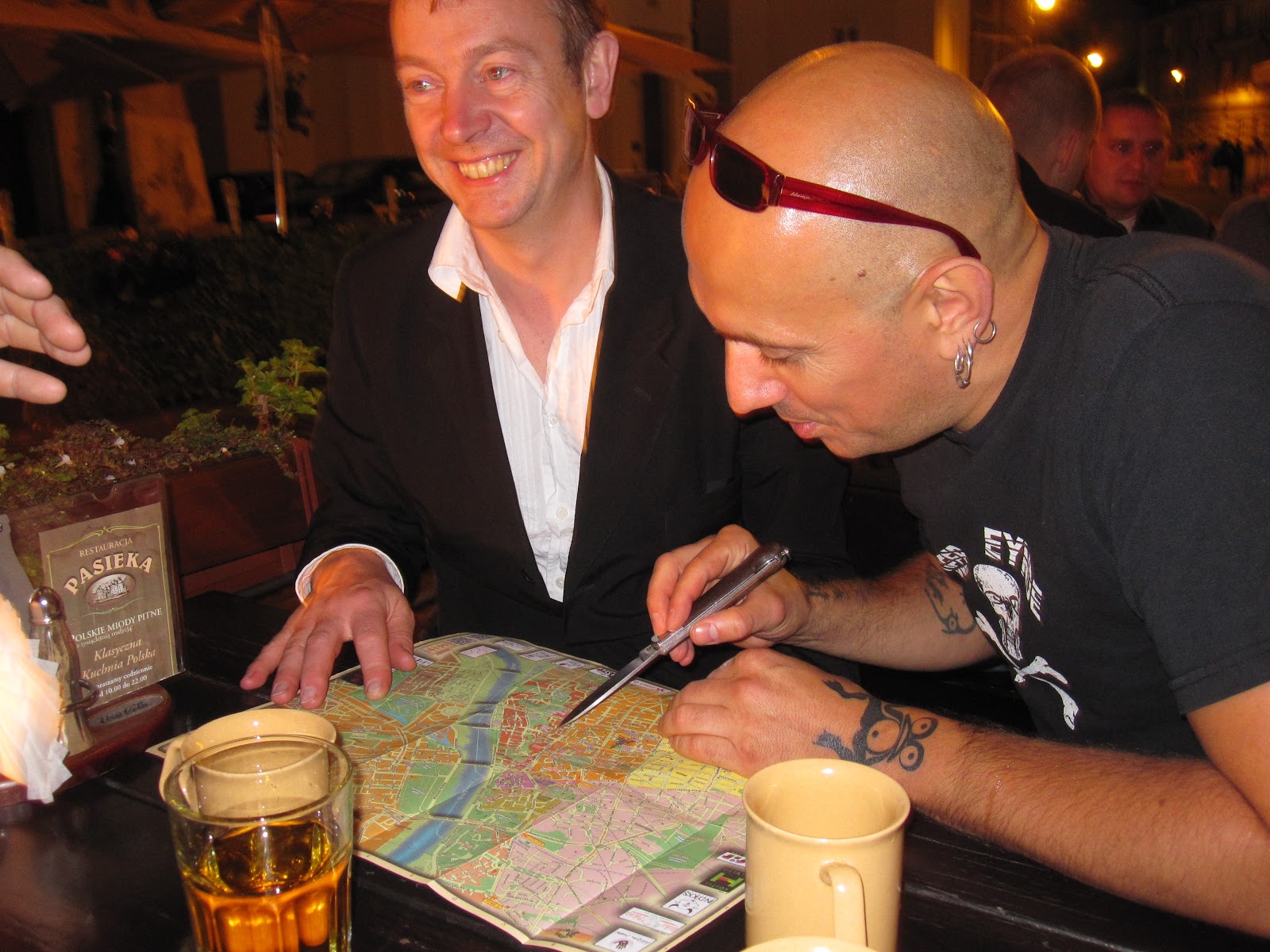
We had such a good time in Warsaw the last time we were there - I was quite shocked to find that was two whole years ago - that spirits were high as we headed into town with our friend and gig promoter Tomek, a legendary figure in Death Rock circles across Europe. He's a man who also commands respect from us because he carries a considerable flick knife .. but he uses that to point to places on the map at various moments during our stays. So that's all right.

We toasted our good fortune at meeting again and our return to Warsaw with a little vodka snifter at the bar where we were playing.

We talked about stage times and equipment and how the soundcheck had gone, and then we had another quick one.

"How was Tomek keeping?" we wondered.  "Not bad," he said. "I'll tell you more later."

For those who don't know Warsaw there's a very wide and long main street with bars at various intervals which becomes an evening promenade for lovers, friends, city visitors. Two thirds of the way down there's a cut through to the Chopin Museum, which is where Frederyk spent some time as a young man before making his way to Paris where he made his name.

Like Vienna and Mozart actual downtime on these flagstones is quite limited but the museum is very tastefully done and there's a great research department... all that lay ahead, but on the Friday night we toasted the musicality of Chopin with a little salute in honey vodka, procured by Tomek from a liquor store a few minutes previously.

By now things were going really well and we were heading through parks and back streets seeing parts of Warsaw we'd never seen before. This honey vodka was quite something.. and very portable.

Obviously we discussed the people who would come to the gig and the set we would do, and how we might play a few songs from our latest album Death Message Blues that Tomek had pressed up on vinyl and we were here to promote.
Oh yes. It was shaping up into a champion evening.

But wait. We stopped for a pint outside one of Warsaw's oldest restaurants, parts of which dated back to the 14th Century.
Except it wasn't a pint of beer, it was a pint of honey mead. We'd decided against that on our previous visit, which had begun with an 0400 alarm call and a drive from Manchester down to Liverpool Ken Dodd International.  By the time we'd arrived in Warsaw we 'd been ready for a kip rather than a big session.

Not this time, we were having a great night out. Bring it on - delicious!

Perhaps Tomek might show us where we are on the map?  "No problem," he said, producing the huge flick knife and jabbing to our whereabouts on the map. Classy.  The waiter coming with the bill faltered... then headed over to another table.

Having been educated about the delights of 999 vodka on previous trips to Warsaw and Lithuania - also in the company of Tomek - we were enjoying the vodka libation enormously, as Harry was happy to note in the picture (left). We saw a few more sights then got our heads down in a flat kindly lent to us by one of Tomek's friends.

So a great night all round, spanning tourism, professional discussions about the gig the following night and catching up with old friends. Tomek did tell me what had been going on but to be honest it slips my mind now.

The gig was fabulous, the Warsaw crowd were excellent, the sound men and the people working on the concert were first class - we even had food laid on. And I tell you what: after a night on the honey vodka, that is very, very welcome.

Warsaw. What people, what a place. Great attitude. I can't wait for us to go there again.